How British Columbia's police discipline system handles gender-based violence, compared with every other kind of misconduct.
What this site covers
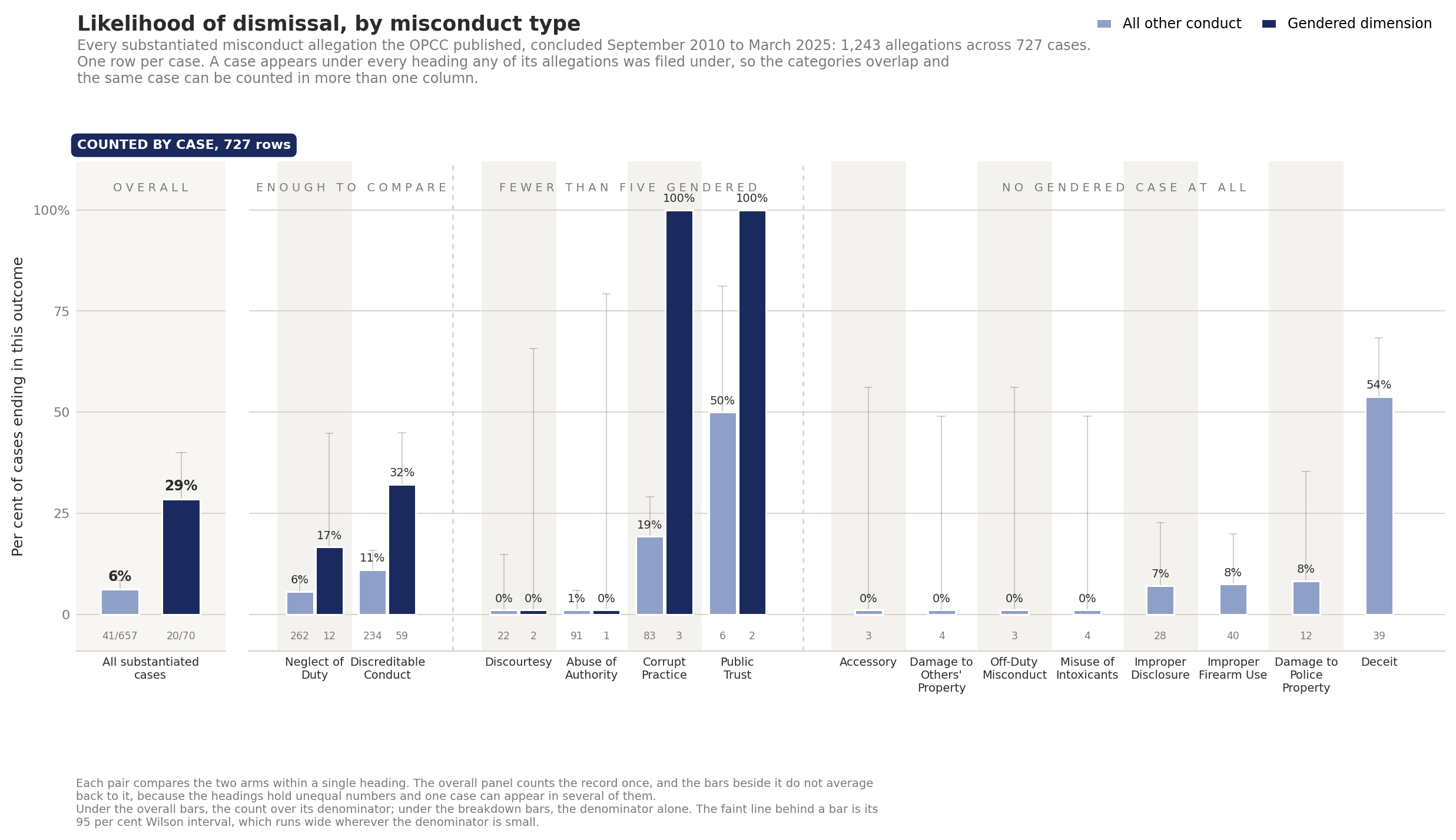
The Office of the Police Complaint Commissioner publishes a summary of every concluded discipline case involving a municipal police officer in British Columbia. This site covers September 2010 to March 2025: 1,243 allegations across 727 cases in 15 agencies. The record appears here as the OPCC published it, including the officers it names. We added one flag, for gender-based violence. It marks 107 allegations across 70 cases, and its rules, with the recorded reason for every case it marks, have their own page.
Dismissal
counted by case
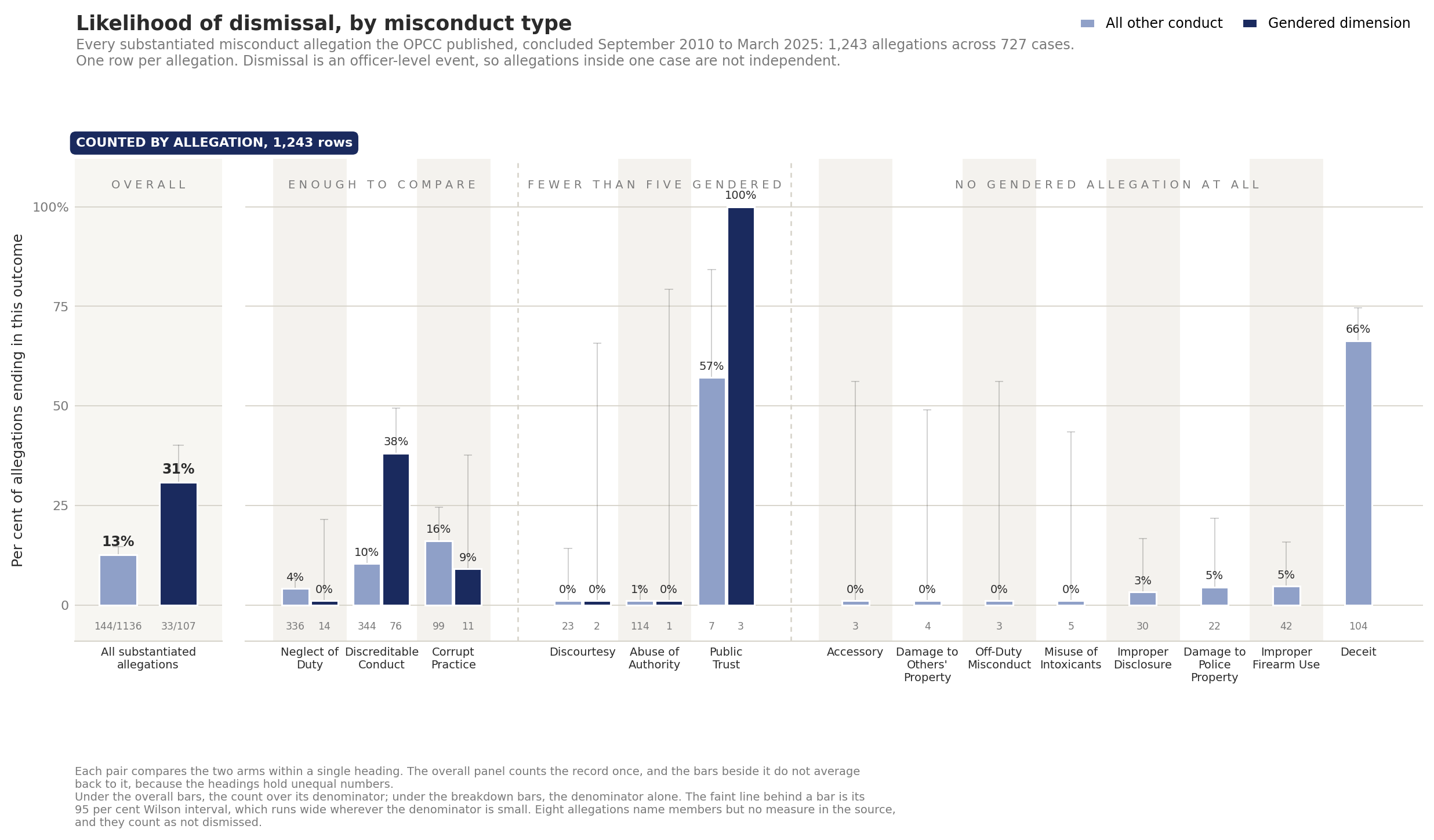
The gap holds when counted by allegation: 33 of 107 gender-based violence allegations carry a dismissal, against 144 of 1,136 for the rest. The figures below run the same comparison inside each statutory heading. The heading bars do not average back to the overall pair; the headings hold unequal numbers, and one case can appear under several.
Dismissal or demotion
counted by case
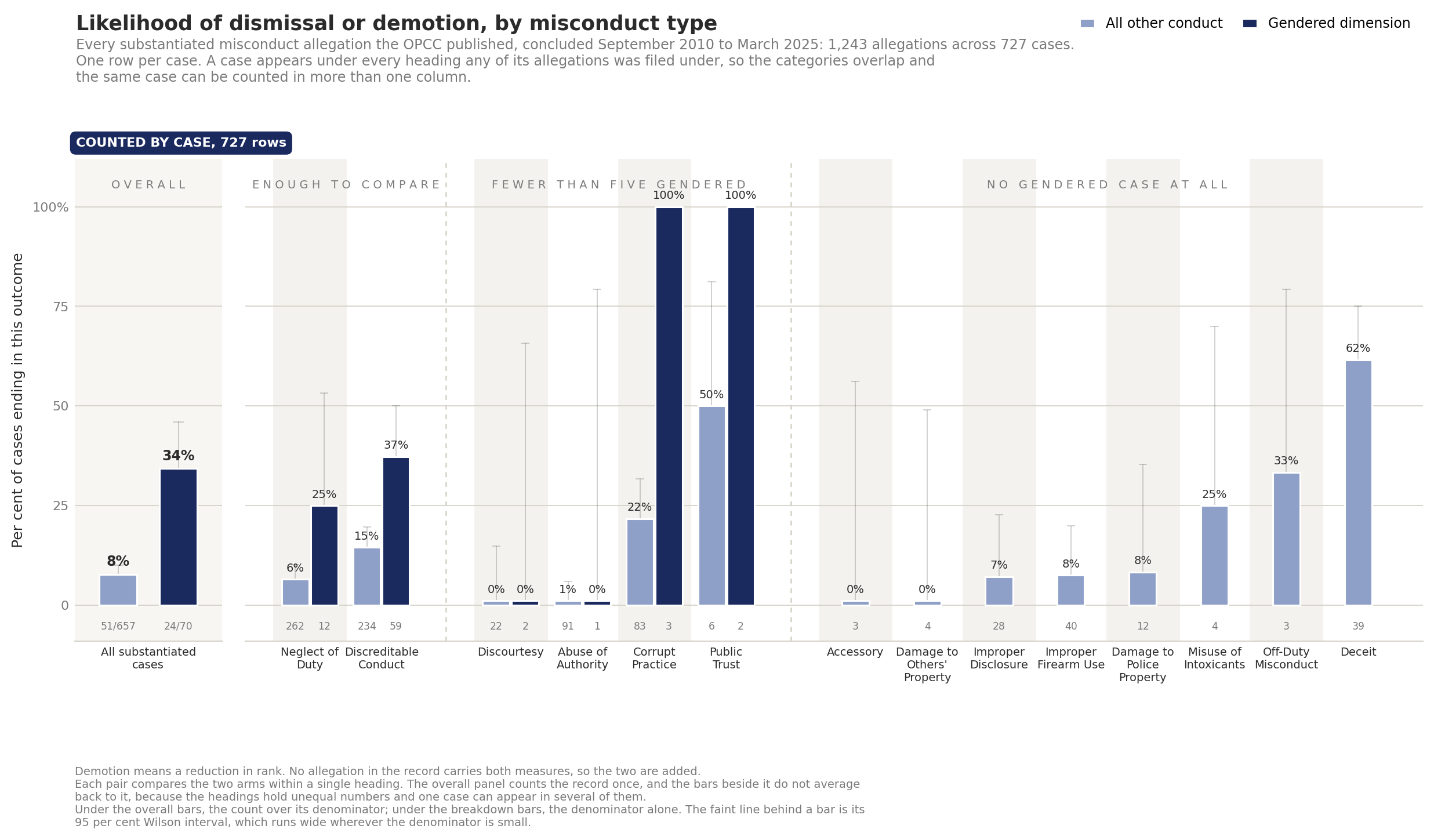
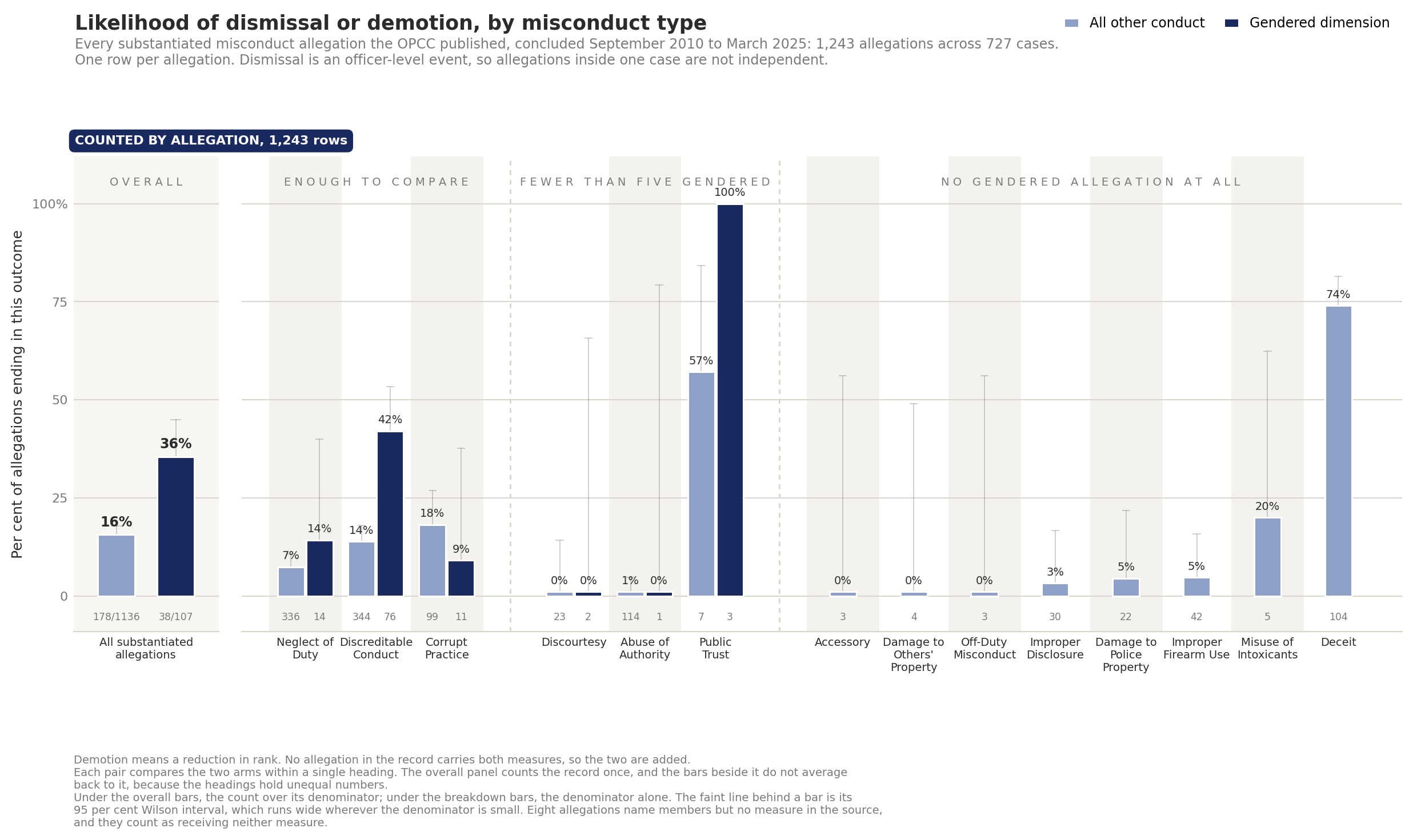
No allegation carries both a dismissal and a reduction in rank, so adding the two double-counts nothing. Counted by allegation, the combined outcome reaches 38 of 107 gender-based violence allegations and 178 of 1,136 of the rest.
Three patterns behind the gap
Most gender-based violence allegations are filed as Discreditable Conduct
counted by allegation
The Police Act gives fourteen headings a charge can be filed under. Gender-based violence sits almost entirely under one of them: 76 of the 107 allegations are Discreditable Conduct. So the overall gap is mostly a fact about that one heading, and inside it the gap is wide:
| Ended in dismissal, inside Discreditable Conduct | Count | Rate |
|---|---|---|
| Gender-based violence allegations | 29 of 76 | 38 % |
| All other allegations under the heading | 36 of 344 | 10 % |
Deceit ends in dismissal for 69 of 104 of its allegations (66 %); only Public Trust Offence, with 10 allegations in total, runs higher. No gender-based violence allegation is filed under the Deceit heading. The files still overlap: 9 of the 65 cases holding a deceit allegation also hold a gender-based violence allegation under a different heading, and 6 of those 9 ended in dismissal.
Why Corrupt Practice runs the other way
In the figures above, Corrupt Practice is the one heading where gender-based violence allegations end in dismissal less often than the rest: 1 of 11, against 16 of 99. One officer's file produces that reversal, since nine of the eleven are his.
That file, 2017-13349, holds 25 allegations. The officer sent sexually explicit messages to women through his department email and phone, and he was dismissed. The charges for using police equipment were filed as Corrupt Practice, 14 allegations; the charges for what he did to the women were filed as Discreditable Conduct, 11 allegations. The record writes his dismissal on the 11 Discreditable Conduct allegations and on none of the 14 Corrupt Practice ones, so his dismissal never shows up under Corrupt Practice.
Cases with gender-based violence are charged more heavily
counted by case
A case with a gender-based violence allegation carries a median of 2 allegations; other cases carry a median of 1. About half of these cases (49 %) rest on a single allegation; 69 % of other cases do. One in ten carries five or more allegations; among other cases, about one in 35 does. Removing the largest file changes little: without 2017-13349, these cases still average 2.2 allegations against 1.6.
This matters for reading the figures. A dismissal is one event for one officer, however many allegations the case holds, and the record writes it beside some of the case's allegations and not others. In heavily charged cases, many allegations show no dismissal beside them, which is why the allegation-level percentages sit lower than the case-level ones.