The discipline system handles gender-based violence the way it handles deceit, and not the way it handles unnecessary force. Four figures show the pattern and how the record changed over fourteen years.
A note on the counts
The figures on this page use the fourteen conduct categories described on the methods page. In that coding, gendered and sexualized violence covers 99 allegations; the flag on the other pages covers 107. The two sets share 86 allegations, and each figure states which set it uses.
Each allegation carries one conduct category, and the categories are held apart so that no allegation is counted twice. A row for one category therefore never contains an allegation belonging to another, which is a rule about how these tables are built rather than a fact about the files. Files often carry both: 9 of the 65 cases containing a deceit allegation also contain a gender-based violence allegation, and 6 of those 9 ended in dismissal.
The kinds of misconduct treated alike
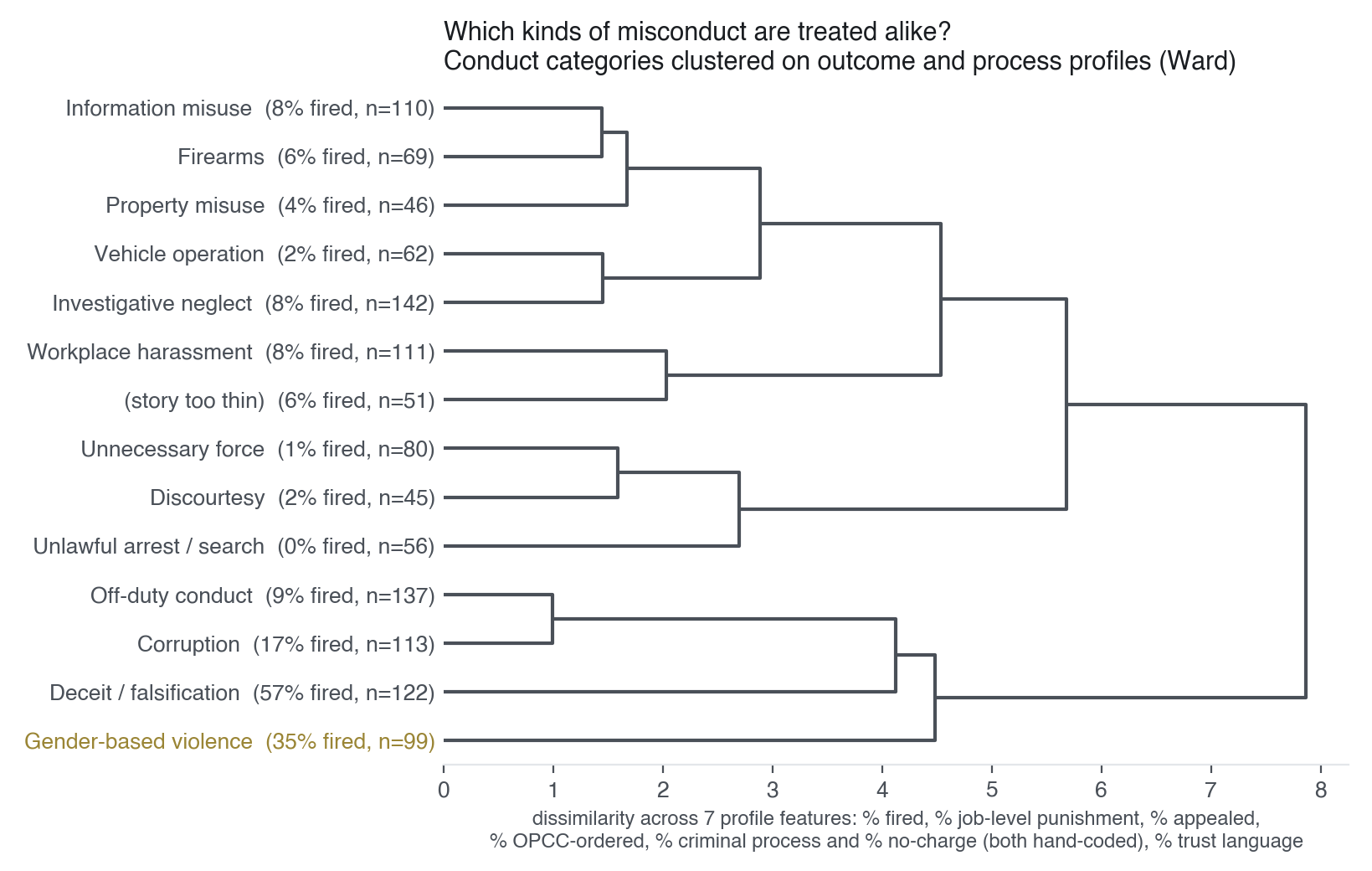
The first figure describes each conduct category by seven numbers: how often it ends in dismissal (the figure's "fired"), how often the punishment reaches the officer's job (dismissal, demotion or suspension), how often the case is appealed, how often the OPCC ordered the investigation, how often a criminal process ran alongside, how often Crown counsel approved no charge, and how often the decision speaks of public trust. Categories that score alike on these seven join the tree early; categories the system handles differently join late.
Gender-based violence joins the branch that holds deceit, corruption and off-duty conduct. Unnecessary force and discourtesy, the categories nearest to it in ordinary language, sit in a different branch. The tree describes how these cases were handled; it does not say why.
The same pattern on one plane
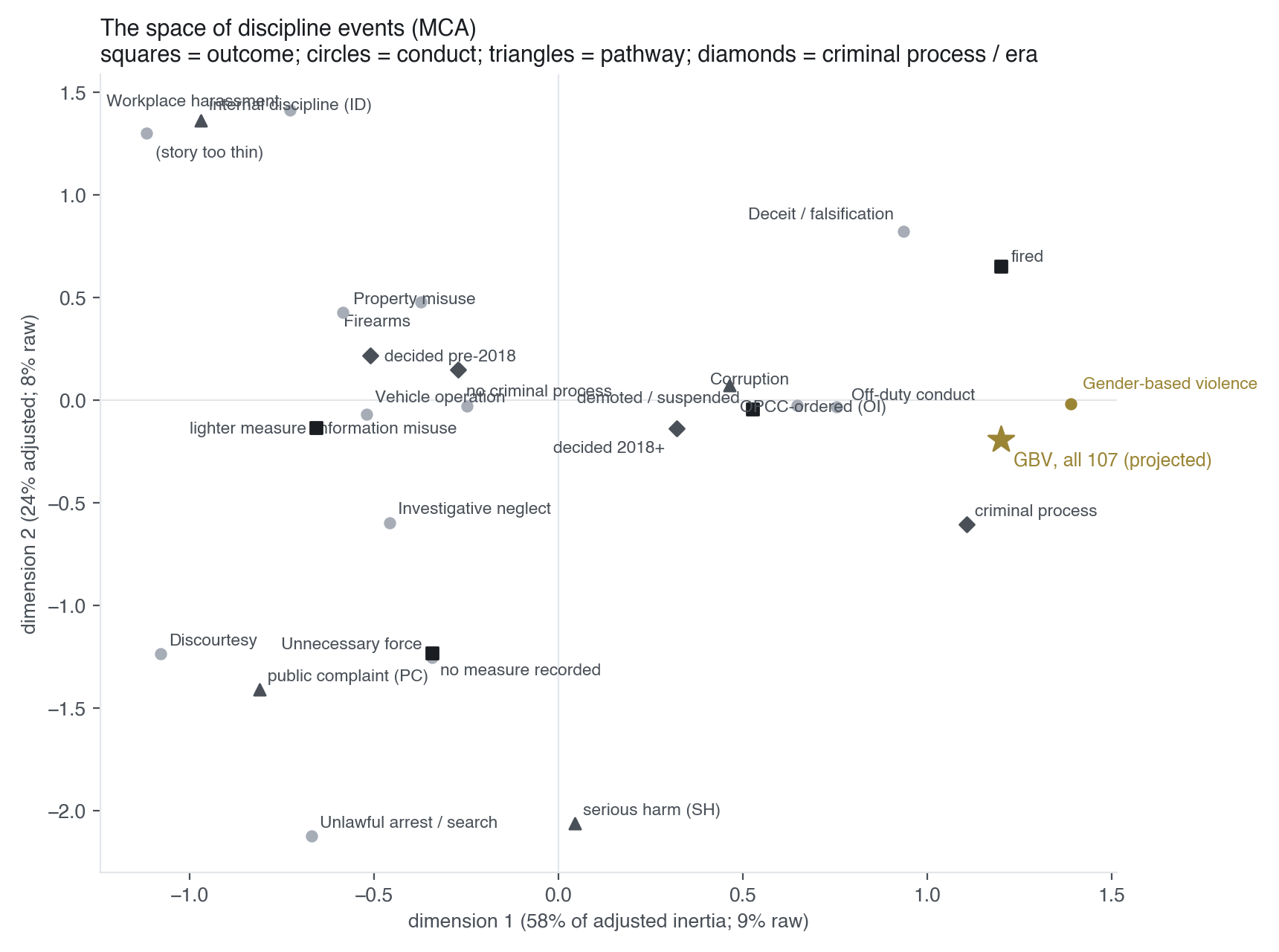
The second figure places outcomes, conduct types, entry pathways and criminal-process markers on one plane. Outcomes and markers recorded in the same allegations sit near each other. Gender-based violence sits beside deceit and beside dismissal (the point the figure labels "fired"), far from force, discourtesy and unlawful arrest. Read distances here as rough neighbourhoods, no more.
The same record over time
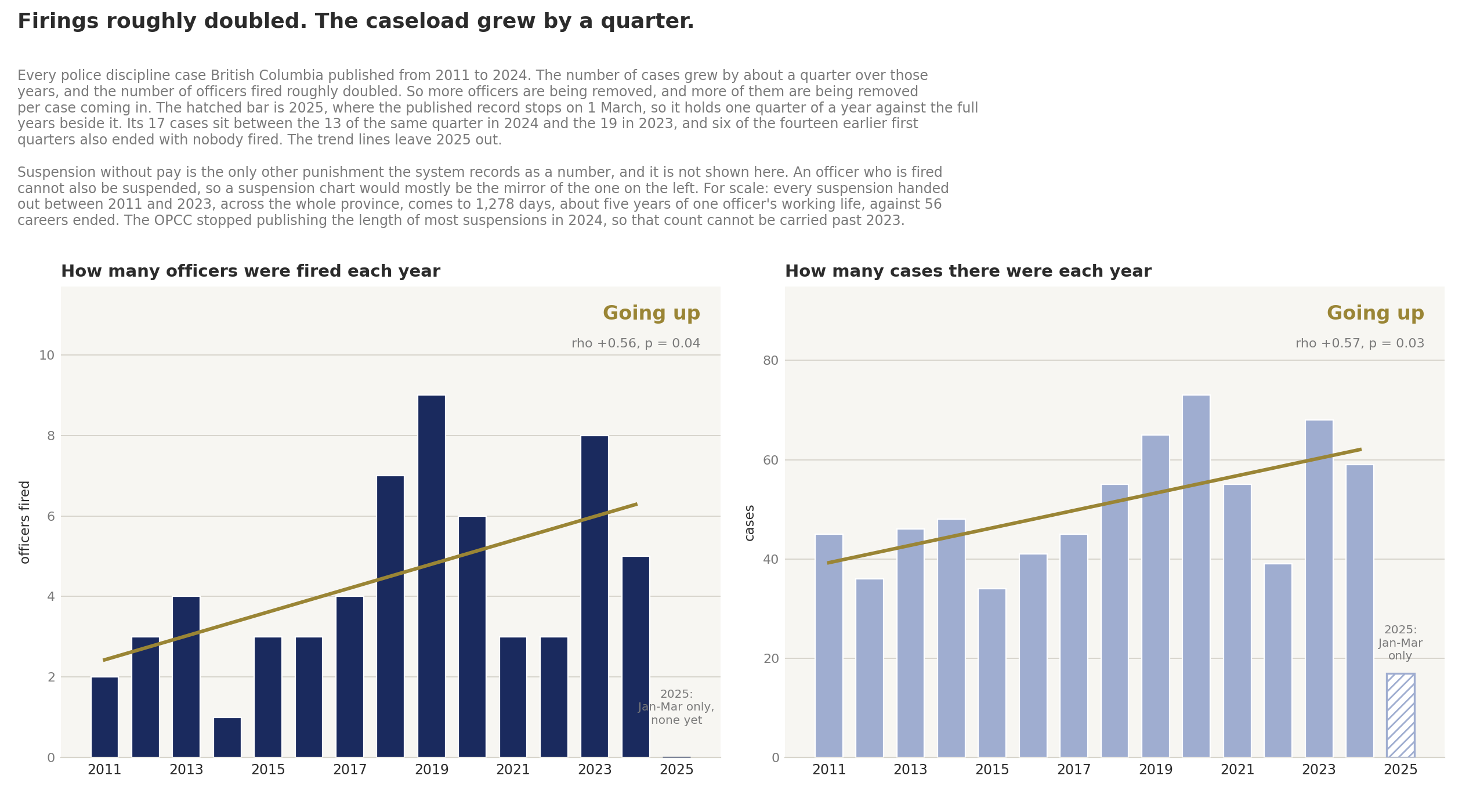
The third figure counts cases and dismissals by the year the case concluded. Across the complete years, 175 cases were concluded in 2011 to 2014 and 221 in 2021 to 2024, a rise of about 26%. The dismissals in those same two spans went from 10 to 19, a rise of about 90%. Officers were removed more often, and more often per case that came in.
Both series count what the OPCC published and substantiated, so a rise may reflect what reaches a published decision as much as what officers did. The province's authorized strength also grew over these years; the department size page gives the 2023 figures.
Suspension without pay is the only other measure the record carries as a number, and it is not plotted. An officer who is dismissed cannot also be suspended, so a suspension series would largely invert the dismissal series. The length is blank on most suspensions recorded in 2024, so that count cannot be carried past 2023.
The hatched bars are 2025, where the published record stops on 1 March. Those 17 cases are one quarter of a year standing beside full years, and the fitted lines leave them out.
The penalty, not only the dismissal
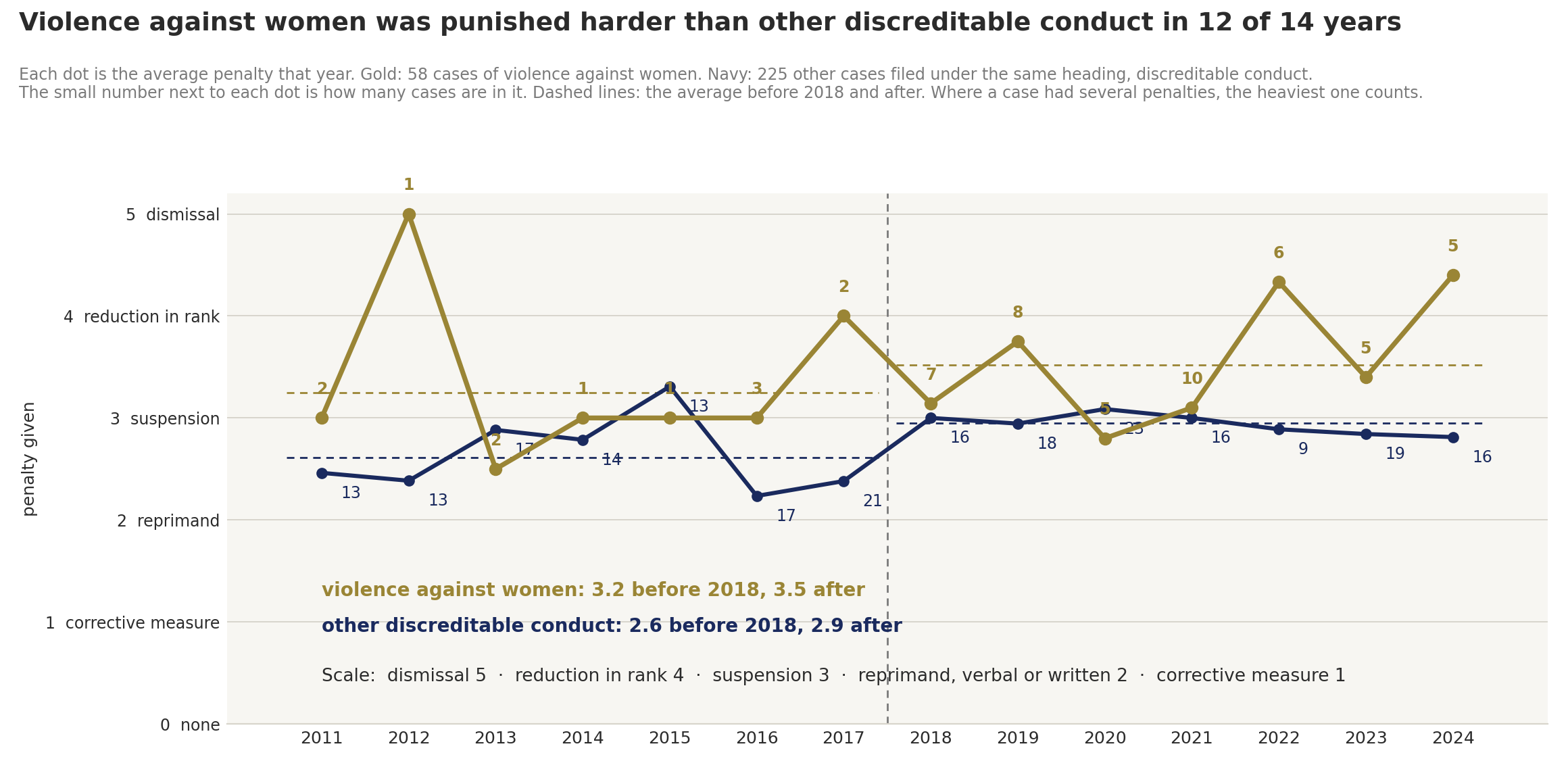
Dismissal is one outcome. The fourth figure scores every penalty on a five-step scale, dismissal 5, reduction in rank 4, suspension 3, a reprimand of either kind 2, any corrective measure 1, and takes the heaviest one in the case. It compares the 58 cases of violence against women filed as discreditable conduct with the 225 other cases filed under that same heading, year by year.
The gendered cases sit higher in twelve of the fourteen years. They average 3.2 before 2018 and 3.5 after, between a suspension and a reduction in rank; the other cases under the heading average 2.6 and 2.9, between a reprimand and a suspension. Both lines rise a little after 2018. The gap between them does not close.
Before 2018 the gold line rests on one to three cases a year, so its early swings are single decisions. The number beside each point is the count of cases behind it.